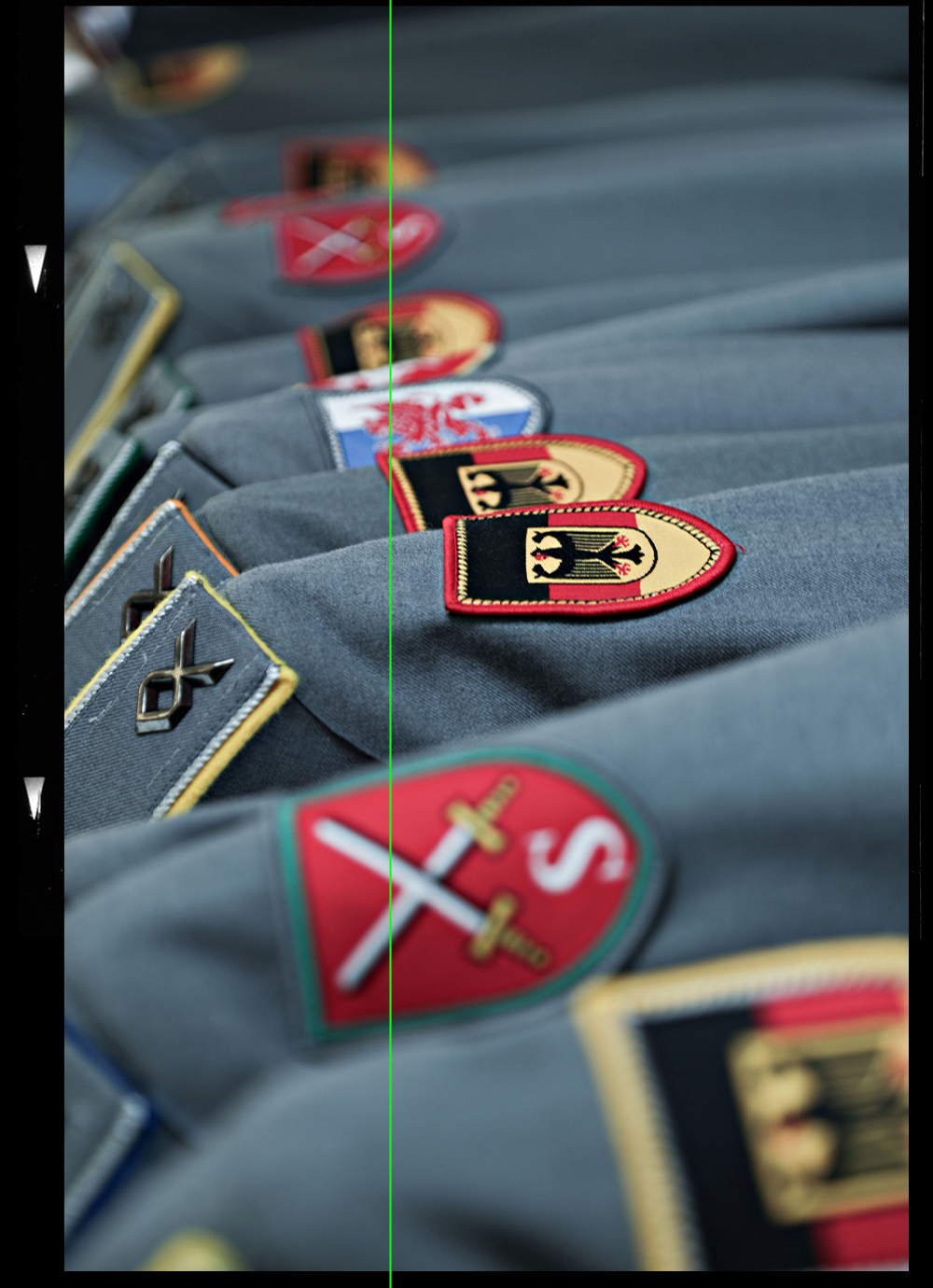


Two powerful forces meet up again, 20 years on: German Military Forces and Hamansutra. 20 years ago, when I was a student at Central St Martins College in London, I did an internship at the Munich-based Clothing Department of the German Military Forces as a tailor’s assistant, where I learnt to appreciate the value of timeless design.
Fast forward 20 years, and let’s take a peek at my 2022 project with the German Military Forces. It’s in line with the times we‘re living through. And that’s exactly why it came about. Back then, during production and preparation of the German army uniforms, the atmosphere in my bunker workshop was tense. Working in a strict code of silence, only breaking it to request assistance from an inspector. Under time pressure to get the uniforms finished, which is absolutely not the way I prefer to work. But I never forgot what all the military vintage clothing from my archive looked like; really rough and raw, put together at incredible speed on high-precision machines for the “mass market” of war. There’s no place there for the kind of painstaking, focused work I do in my own studio.
The uniforms fall into three categories. The first is bespoke, tailor-made. The second is made on a modular “kit” basis, and the third is the “kit” uniform, but recycled and reused. I was assigned to the bespoke category, way back in 2003.
Uniforms are full of secrets. When squaddie Hans Meier (or Joe Bloggs, or John Doe) collected his sergeant’s uniform, he was already thinking about his next promotion. 18 months later… Preparing for production of a Military Police Corps uniform. Collar tabs preserved in baking parchment. Beautifully produced accessories and notions, great to work with. That moment when soldiers attach their nametapes. When I first started in military tailoring, I began to use nametapes like them as branding on my clothes. Made to German military specifications.
I noticed that for many of the civil servants there – because let’s face it, that’s what they were – art and craftsmanship in any form were supremely boring. It was all about mass manufacturing. Their spark had been stifled, and the only thing they looked forward to was getting their pension. Working alongside that lacklustre retiree mentality is usually hellish for designers. Those people can look back on a life of stability, but that life is a black hole that has sucked in any creativity, joy and inspiration they once had.
These days my work is project-based, so I can always step back and regain some pleasure from working in that atmosphere. But it’s rare that my energy can carry across the divide and infect others. As a freelancer, I’m like an A&E surgeon. No time to fuck about. Heart stopped beating? Grab that scalpel, slash open the torso and go right in with bare hands to massage it back to life. I learn, I document what I learn, and I meticulously apply it in my projects. That means many things end up having more in common with a scientific study than a piece of fashion. The process is more important than the result. And when I reach a result, it’s all my own work and I don’t need to start pulling it to pieces.
I constantly weave updates into my designs, but the pen pushers don’t want to know. Promotion is always beyond their reach, but the question is which is their biggest enemy – their head or their body? Is the body just a machine for transporting the head to the office? Or is it the other way round, and the head’s true enemy is actually the lethargic apathy of the body? If companies don’t come up with their own strategy for employing creative minds, I’ll use those companies for my own purposes and make sure they spit out the occasional interesting project. With my help, and with force if need be. People of the world unite, and set up workshops in your garages! They’ll serve as incubators, as laboratories for all the developments that will be so important later on.
© 100% hamansutra

Two powerful forces meet up again, 20 years on: German Military Forces and Hamansutra. 20 years ago, when I was a student at Central St Martins College in London, I did an internship at the Munich-based Clothing Department of the German Military Forces as a tailor’s assistant, where I learnt to appreciate the value of timeless design.
Fast forward 20 years, and let’s take a peek at my 2022 project with the German Military Forces. It’s in line with the times we‘re living through. And that’s exactly why it came about. Back then, during production and preparation of the German army uniforms, the atmosphere in my bunker workshop was tense. Working in a strict code of silence, only breaking it to request assistance from an inspector. Under time pressure to get the uniforms finished, which is absolutely not the way I prefer to work. But I never forgot what all the military vintage clothing from my archive looked like; really rough and raw, put together at incredible speed on high-precision machines for the “mass market” of war. There’s no place there for the kind of painstaking, focused work I do in my own studio.
The uniforms fall into three categories. The first is bespoke, tailor-made. The second is made on a modular “kit” basis, and the third is the “kit” uniform, but recycled and reused. I was assigned to the bespoke category, way back in 2003.
Uniforms are full of secrets. When squaddie Hans Meier (or Joe Bloggs, or John Doe) collected his sergeant’s uniform, he was already thinking about his next promotion. 18 months later… Preparing for production of a Military Police Corps uniform. Collar tabs preserved in baking parchment. Beautifully produced accessories and notions, great to work with. That moment when soldiers attach their nametapes. When I first started in military tailoring, I began to use nametapes like them as branding on my clothes. Made to German military specifications.
I noticed that for many of the civil servants there – because let’s face it, that’s what they were – art and craftsmanship in any form were supremely boring. It was all about mass manufacturing. Their spark had been stifled, and the only thing they looked forward to was getting their pension. Working alongside that lacklustre retiree mentality is usually hellish for designers. Those people can look back on a life of stability, but that life is a black hole that has sucked in any creativity, joy and inspiration they once had.
These days my work is project-based, so I can always step back and regain some pleasure from working in that atmosphere. But it’s rare that my energy can carry across the divide and infect others. As a freelancer, I’m like an A&E surgeon. No time to fuck about. Heart stopped beating? Grab that scalpel, slash open the torso and go right in with bare hands to massage it back to life. I learn, I document what I learn, and I meticulously apply it in my projects. That means many things end up having more in common with a scientific study than a piece of fashion. The process is more important than the result. And when I reach a result, it’s all my own work and I don’t need to start pulling it to pieces.
I constantly weave updates into my designs, but the pen pushers don’t want to know. Promotion is always beyond their reach, but the question is which is their biggest enemy – their head or their body? Is the body just a machine for transporting the head to the office? Or is it the other way round, and the head’s true enemy is actually the lethargic apathy of the body? If companies don’t come up with their own strategy for employing creative minds, I’ll use those companies for my own purposes and make sure they spit out the occasional interesting project. With my help, and with force if need be. People of the world unite, and set up workshops in your garages! They’ll serve as incubators, as laboratories for all the developments that will be so important later on.
© 100% hamansutra
Long Live The McQueen


“When I gave Alexander McQueen my pants”
After 9/11 2001, hamansutra met Alexander McQueen for an interview in London. The two women there as showroom managers were pretty unfriendly, and one of them even mocked haman’s British English street slang. Lee McQueen had been on the lookout for classic tailors able to perform tasks like hand-stitching eyelet buttonholes. But there was nothing free for the 22-year-old haman and they never worked together. And yet McQueen told haman, “We’re the same. Creative. I can see it in your sketchbooks.” Lee Alexander McQueen accepted haman’s German military pants and original sketch as a gift, with a hand-written dedication. Haman had the pants for a long time, good quality industrial manufacture, cheap, not trendy, a German-made product. The quality used to be better, but production moved abroad after the Second World War. A picture showing Lee Alexander McQueen actually wearing the military pants in his studio, has now been used for the cover of “Alexander McQueen – The Life and the Legacy” by Judith Watt, a globally published examination of the designer. The location of the picture was Amwell Street, London, near Angel in Islington, where McQueen lived within walking distance of his studio. Central St Martins College from the late 90s to 2010 was Alexander McQueen’s best time. If he were alive today he would still be the Number One. He went his own way and had his associates, who brought him up but also dragged him down – like the corporation that owned 51% of his company. The deaths of Isabella Blow and his mother were bitter blows; he was also under pressure from Gucci Group to deliver more commercial designs. A hoodie with the McQueen logo? Never! And yet he was an irreplaceable role model to us as St. Martins graduates. He shaped and formed us; we grew up surrounded by his superhuman energy and took on the responsibility and the pressure to match his quality, imposed by the same college and tutors. After his death in 2010 hamansutra decided to delete all his social media accounts. The news was like a physical blow, it caused complete numbness. Sometimes you wonder how people like that got to be so good – but take Alexander McQueen: I know that after CSM closed every day, he would hide under the tables in the pattern room to carry on working on his collection at night. It’s pretty sad that nobody can respect Alexander McQueen’s wishes and close the house. People and Gucci Group should have respected his wishes. They are too money hungry to care! Sad that creativity and industry can’t walk together for long. However, Lee McQueen made you dream, made you hopeful, made you love life…made you love fashion…he made us love art. His death was the culmination of his art. Rest in Paradise, brother.
Re-issue of the German Military Pants / Updated by Hamansutra
Available in 2020 at quickshop.nyc
10TH REMEMBRANCE YEAR
IN MEMORY OF ALEXANDER MCQUEEN
(* 1969 – 2010)
Lee Alexander Mcqueen
alexandermcqueen.com
Photography
derricksantini.com
BUY
QUICKSHOP.NYC
“When I gave Alexander McQueen my pants”
After 9/11 2001, hamansutra met Alexander McQueen for an interview in London. The two women there as showroom managers were pretty unfriendly, and one of them even mocked haman’s British English street slang. Lee McQueen had been on the lookout for classic tailors able to perform tasks like hand-stitching eyelet buttonholes. But there was nothing free for the 22-year-old haman and they never worked together. And yet McQueen told haman, “We’re the same. Creative. I can see it in your sketchbooks.” Lee Alexander McQueen accepted haman’s German military pants and original sketch as a gift, with a hand-written dedication. Haman had the pants for a long time, good quality industrial manufacture, cheap, not trendy, a German-made product. The quality used to be better, but production moved abroad after the Second World War. A picture showing Lee Alexander McQueen actually wearing the military pants in his studio, has now been used for the cover of “Alexander McQueen – The Life and the Legacy” by Judith Watt, a globally published examination of the designer. The location of the picture was Amwell Street, London, near Angel in Islington, where McQueen lived within walking distance of his studio. Central St Martins College from the late 90s to 2010 was Alexander McQueen’s best time. If he were alive today he would still be the Number One. He went his own way and had his associates, who brought him up but also dragged him down – like the corporation that owned 51% of his company. The deaths of Isabella Blow and his mother were bitter blows; he was also under pressure from Gucci Group to deliver more commercial designs. A hoodie with the McQueen logo? Never! And yet he was an irreplaceable role model to us as St. Martins graduates. He shaped and formed us; we grew up surrounded by his superhuman energy and took on the responsibility and the pressure to match his quality, imposed by the same college and tutors. After his death in 2010 hamansutra decided to delete all his social media accounts. The news was like a physical blow, it caused complete numbness. Sometimes you wonder how people like that got to be so good – but take Alexander McQueen: I know that after CSM closed every day, he would hide under the tables in the pattern room to carry on working on his collection at night. It’s pretty sad that nobody can respect Alexander McQueen’s wishes and close the house. People and Gucci Group should have respected his wishes. They are too money hungry to care! Sad that creativity and industry can’t walk together for long. However, Lee McQueen made you dream, made you hopeful, made you love life…made you love fashion…he made us love art. His death was the culmination of his art. Rest in Paradise, brother.
Re-issue of the German Military Pants / Updated by Hamansutra
Available in 2020 at quickshop.nyc
10TH REMEMBRANCE YEAR
IN MEMORY OF ALEXANDER MCQUEEN
(* 1969 – 2010)
Lee Alexander Mcqueen
alexandermcqueen.com
Photography
derricksantini.com
BUY
QUICKSHOP.NYC
